

For a spot free car wash, the water you finish with should read 0 ppm TDS. That is what purified water from a deionising (DI) tank reads while the resin is fresh, and it dries with nothing left behind. Anything above 0 is dissolved mineral, and the higher the number, the more of it is left on your paint and glass when the water dries. Most Australian tap water reads somewhere between 25 and 400 ppm, with parts of WA well beyond that. Here is what the numbers mean, how to test your own water, and what it takes to get to 0.
What TDS actually measures
TDS stands for total dissolved solids: everything dissolved in the water that is not water itself. Calcium, magnesium, sodium, chloride, bicarbonate, silica and more. It is measured in parts per million (ppm), which is the same as milligrams per litre, so a reading of 300 ppm means every litre carries 300 mg of dissolved mineral.
You cannot see it in a glass, and it is perfectly fine to drink. You only notice it when the water evaporates. The water leaves, the minerals stay, and each dried droplet becomes a white ring on the paint. That is all a water spot is. Our guide to what causes water spots covers the different types and how they can etch in over time.
Why the target is 0, not just low
A final rinse on a car uses about 25 to 35 litres. At 300 ppm, 30 litres of rinse water carries around 9 grams of dissolved mineral over your car. Most of it runs off, but every droplet that stays behind dries with its share. At 50 ppm there is far less, which is why soft water areas spot more lightly, but it is still something. At 0 ppm there is nothing in the water to leave behind, so it does not matter how fast it dries, how hot the day is or how dark the paint is.
That is the whole idea behind a spot free rinse: get the last water that touches the car to 0, then let it air dry.
What different water reads
Here is how common water sources typically read, and what you can expect when they dry on a car.
| Water | Typical TDS | What you see when it dries |
|---|---|---|
| DI tank with fresh resin | 0 ppm | Nothing left behind. Air dries clean, even in full sun. |
| Reverse osmosis (RO) | 5 to 20 ppm | Much better than tap, but can still dry with faint marks on dark paint and glass. |
| Rainwater tank, clean roof | 10 to 30 ppm | Light spotting. Roof dust and debris can push the reading higher. |
| Soft town water (Cairns, Hobart, Melbourne, Canberra) | About 25 to 80 ppm | Spots still show on dark paint and glass, just lighter than most of the country. |
| Moderate town water (most of Sydney, Newcastle, Darwin) | About 90 to 150 ppm | Visible spots whenever water dries, especially in the sun. |
| Harder town water (Brisbane's south side, Adelaide, much of regional Queensland) | About 180 to 400 ppm | Spots form fast and towel drying turns into a race. |
| Hard town water and bores (most of Perth, the WA Wheatbelt and Mid West, many bores) | 400 ppm and up | Heavy spotting, and minerals left to bake in the sun can etch into clear coat. |
The figure for your own suburb is in our Australian tap water TDS guide, which covers 278 towns and supply zones using each water authority's published data. If you are on a bore, our guide to washing your car with bore water covers the extra steps.
Why filters, softeners and RO do not get you to 0
- Tap and carbon filters improve taste and take out chlorine and sediment, but leave the dissolved minerals in. Your TDS reading barely moves.
- Water softeners swap calcium and magnesium for sodium. That cuts scale in pipes and appliances, but the total dissolved solids stay in the water, so it still spots.
- Reverse osmosis removes most of the minerals and typically reads 5 to 20 ppm. Good, but not 0, and on dark paint in the sun that can still show. Serious RO setups finish with a DI stage for exactly this reason.
- Distilled water is close to 0, but buying or making 25 to 35 litres for every wash is not practical.
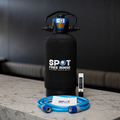
Deionisation is the method that gets you to 0 on demand from a garden hose. Resin inside the tank swaps the dissolved mineral ions for hydrogen and hydroxide ions, which recombine into pure water. No power, no pump and no plumbing. Our comparison of DI, RO, softeners and distilled water lays the options side by side.
How to test your water
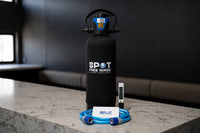
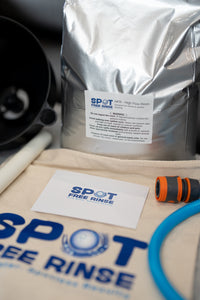
A TDS meter is a pen sized tester that gives you a reading in seconds, and every Spot Free Rinse tank comes with one in the box. To test your tap:
- Take the cap off the meter. The cap doubles as the sample cup.
- Fill the cap with cold tap water.
- Sit the meter in the cap and wait for the number to settle.
To check the tank's output, run water through the tank for about 10 seconds, catch some of the output in the cap and read it the same way. With fresh resin it reads 0 ppm.
It is worth testing your tap a few times through the year. Water authorities blend different sources with the seasons, so the same tap can read quite differently in summer and winter.
When the tank reading starts to climb
Resin has a set capacity. Every litre of tap water it purifies uses a little of it, and as it nears the end, the output reading starts to rise. The meter tells you exactly where you stand:
| Tank output | What it means |
|---|---|
| 0 to 5 ppm | Working. Wash away. |
| 6 to 10 ppm | On its way out. Order a resin kit. |
| Above 10 ppm | Replace the resin now. |
The swap takes about 15 minutes with a resin replacement kit, and our step by step resin guide shows the whole job on video.
Your tap reading decides how long the resin lasts
The higher your tap TDS, the more mineral the resin has to pull out of every litre, so the sooner it is used up. A tank on 50 ppm water lasts roughly six times as long as the same tank on 300 ppm water. The finish is the same either way, 0 ppm from fresh resin, but harder water means more frequent resin changes. That is why your tap reading is the first thing to check when choosing a tank size. Pop it into the Water Spot Calculator to see what each tank gives you, and our resin life guide has the figures for each size.
Using the tank for the final rinse, with tap water for the wash, stretches every resin fill much further. The full method is in our guide to washing your car without water spots. Wash. Rinse. Pack up.
Frequently asked questions
What TDS level is spot free?
0 ppm. At 0 there are no dissolved minerals left to dry on the surface. A DI tank with fresh resin reads 0 ppm.
Is 10 ppm good enough to wash a car?
It is the point to replace the resin. Around 10 ppm, faint marks can start to show on dark paint and glass, especially in the sun.
What is a normal TDS for Australian tap water?
Anywhere from about 25 ppm in Cairns to more than 850 ppm in Geraldton. Melbourne sits around 50, most of Sydney between about 90 and 145, Brisbane's blended grid averages around 300 and most of Perth reads above 400. It is all safe to drink: the Australian Drinking Water Guidelines treat TDS up to 600 ppm as good for taste.
Does a water softener lower TDS?
No. A softener swaps calcium and magnesium for sodium, so the total dissolved solids stay in the water and it still spots.
How do I check my TDS?
Use a TDS meter. Fill the meter's cap with cold water, sit the meter in it and read the number once it settles. Every Spot Free Rinse tank includes one.