


Frequently Asked Questions & More Information
Got questions? You're not alone! Here are the most common things people ask us about Spot Free Rinse — and the answers you need to rinse with confidence.
How Many Rinses Will I Get?
Q: How long does the resin last, and how many rinses can I expect?
A: Resin life depends mainly on your local water quality — specifically the TDS (Total Dissolved Solids) of your tap water. Higher TDS means more dissolved minerals for the resin to remove, so the resin will be used up faster. As a real-world example, we achieved ~500L from a 6L tank on ~290ppm input water.
Estimated output at ~100ppm input water (approx.) and using 30L per rinse:
- Lite (10L): (2,550 to 2,900 L): 85 to 97 rinses
- Pro (15L): (4,000 to 4,500 L): 133 to 150 rinses
- Commercial (25L): (6,700 to 7,500 L): 220 to 250 rinses
Australian tap water typically ranges between 30 ppm and 500 ppm, depending on the source and region. Most areas sit around 100–150 ppm, with some regions higher.
Tip: Wash with normal tap water, then use Spot Free Rinse for the final rinse. That makes the resin last as long as possible.
These figures are estimates because your water quality varies, it fluctuates throughout the year due to rain and other factors. Check your output TDS periodically—when it rises or spots start to appear, it's time to replace the resin.
Q: Can I use it for the whole wash?
A: Yes, if you'd like. We always recommend it for the final rinse, because that makes your resin last as long as possible.
If your final rinse is about a quarter of the water you use, putting the whole wash through the tank uses about four times as much, so the resin lasts about a quarter as long. If you'd rather have the convenience, go for it, especially if you live in a soft water area. If your water is very hard, the resin gets used up much quicker, so you might stick to the final rinse and wash early morning or late afternoon. It's totally up to you. How long it lasts comes down to how much you use it and how hard your water is.
Why would you? Every time water dries on your paint, at any stage of the wash, it leaves a tiny trace of minerals behind. The next drop tends to stop on that tiny ledge, dry there and add to it. Over time it builds up, the finish goes dull and water stops beading the way it should. It's like a shower screen. When it's new, water sheets straight off. Once drops start stopping in the same spots, the marks build and build. Filtered water the whole way through means there's nothing left to dry at any stage.
How many rinses will you get?
Enter your local tap water TDS to estimate resin life. Baseline: ~100 ppm, ~30L per final rinse.
Estimated spot-free rinses
—
Enter your TDS to estimate
Output volume
—
Baseline (100 ppm @ 30L)
—
Wash with regular tap water first — use Spot Free Rinse for the final rinse. This stretches resin life significantly.
Can I replace the resin myself?
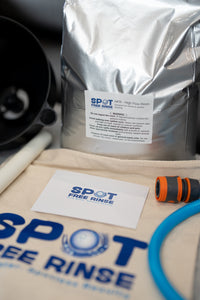
A: Absolutely. The resin in every Spot Free Rinse tank can be replaced. Just unscrew the cap, extract the old resin, and fill the tank with fresh resin. We sell resin replacement kits with all tools and detailed instructions (including a video).
Is purified water safe for my vehicle and windows?
A: 100%! Purified water is actually safer than regular tap water because it contains virtually no minerals — meaning no streaks, no spots, and no residue.
It's safe on:
- Paint and clear coat
- Glass and mirrors
- Chrome, stainless, and aluminium
- Plastic trims and lights
- Solar panels and more
Q: Can I drink the water?
A: No. The tank is built for washing and rinsing, not drinking. A zero reading on the meter tells you the minerals are gone, not that the water is safe to drink.
Do I still need to wash with detergent first?
A: Yes — wash as you normally would with your preferred detergent or car wash solution. Spot Free Rinse is designed for the final rinse stage, replacing your normal tap water rinse so you can skip drying and avoid spots. You also reduce the amount of contact with your vehicle, lowering the risk of scratches.
System & Setup
Q: How do I connect the tank to my hose or pressure washer?
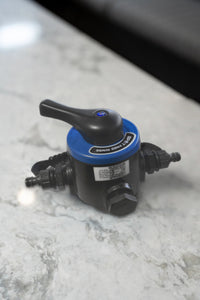
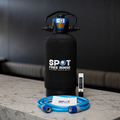
A: The tank always goes straight after the tap. Your tap goes to the IN side, and your hose or pressure washer goes on the OUT side. Every tank comes with standard Australian garden hose fittings and a 2 m connector hose.
With a pressure washer, it's tap, tank, then pressure washer, so the tank only ever sees tap pressure. Never put the tank after the pressure washer. Wash on Bypass, then flick to Filter for the final rinse.

Q: Can I use warm or hot water?
A: No — use cold tap water only. Hot water can damage the resin and reduce its performance and lifespan.
Q: How do I know when the resin is finished?
A: You'll start seeing water spots again after rinsing — that's your first sign. For accuracy, use the included TDS meter. When it reads over 10 ppm, it's time to order a resin replacement kit so your car and windows stay spot free.
Q: I already have a water softener. Will my resin last longer?
A: Unfortunately not. A softener doesn't remove minerals from your water. It swaps the calcium and magnesium that cause scale for sodium, so the total dissolved solids (TDS) stay about the same, and can even rise slightly. Our resin removes everything dissolved in the water, sodium included, so it does roughly the same amount of work either way. Expect about the same resin life as you'd get from that tap without a softener. Your TDS meter is the best guide to when it's time for a resin replacement. Our water softener guide explains it in more detail.
Q: I have a whole house water filter. Do I still need a DI tank?
A: Yes, for a spot free rinse. A whole house filter takes out dirt, chlorine and chemicals, but not the dissolved minerals that cause water spots, so filtered water reads about the same on a TDS meter and still spots when it dries. It won't make your resin last longer either. If your area uses chloramine, check your filter has catalytic carbon, but that changes taste and smell, not spots. Our whole house water filter guide explains each stage.
Orders & Shipping
Q: Do you ship Australia-wide?
A: Yep! We ship all across Australia. Orders ship within the next business day.
Q: What if I need help after buying?
A: We're here for you. Whether it's help setting up, replacing resin, or just questions about using your tank — shoot us an email or message, even give us a call if you need. We're a small Aussie business and we pride ourselves on our relationship with our customers, so you'll always get a real person who knows the product. If you have any questions, or suggestions on how we could improve, we'd genuinely love to hear from you.
What About the Price?
Q: Is Spot Free Rinse worth the cost?
We get it — buying a rinse system might seem like a lot up front. But here's the thing: if you wash your car regularly or take pride in keeping your vehicles clean, Spot Free Rinse pays for itself fast — in both time and money. You get perfect results in half the time, you cut the most boring step out of your routine - the drying.
Let's break it down:
Professional Car Wash vs. Spot Free Rinse
- Basic hand wash & dry at a detailer: $40–$70 per visit
- DIY home wash: Cheap — but takes 45+ minutes if you towel-dry, and still leaves spots unless you work fast in perfect conditions.
With Spot Free Rinse, you wash like normal, then just do a quick rinse with DI water — no towels, no drying. You'll finish faster and with better results than a drive-through or hand wash.
Time Is Money, Too
Let's say you usually spend 15–20 minutes just drying the car to avoid water spots. With Spot Free Rinse:
- No drying required
- No rush before water dries
- Just rinse and let it naturally dry
That adds up to hours saved every year — and a more enjoyable, hassle-free wash routine.
One-Time Setup, Long-Term Benefits
- Resin is fully replaceable — swap it in minutes
- No moving parts to break
- Designed to last
- Safe for all surfaces
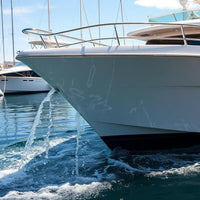
If you care about your car, caravan, boat, or bike — and hate wasting time drying or dealing with spots — Spot Free Rinse is a no-brainer.
Use in Full Sun — No Problem!
Q: Can I use Spot Free Rinse in full sun without worrying about water spots?
Yes! That's one of the best things about Spot Free Rinse: you can wash and rinse in full sun without the usual stress of water spots. Just be sure to rinse the soapy water before it dries.
Normally, when you wash a car in hot, sunny conditions, water dries too quickly on the surface, leaving behind mineral spots and streaks that are almost impossible to remove. With Spot Free Rinse, because our DI water is virtually mineral-free, it won't leave any residue as it dries — even if you're out in the sun.
No More Racing the Clock
In typical conditions, you'd have to rush to dry your car before the water evaporates and leaves those dreaded spots. With Spot Free Rinse, you can simply rinse and let it air dry — no towel, no panic.
- Rinse in full sun without worrying about drying or streaking
- Save time — no need for shade or perfect weather
- Perfect finish — a spot-free result in hot or sunny conditions
Great for Hot Days, Too
On those hot Aussie days when your car is baking in the sun, regular water spots can be especially difficult to avoid. With Spot Free Rinse, the water dries quickly but without the spots. So you can wash whenever it fits into your schedule, even if the sun's beating down.
With Spot Free Rinse, you don't need to wait for overcast days or shaded spots — you can get a professional-grade, spot-free finish no matter where or when you wash. Whether you're cleaning your car, boat, caravan, or even windows in the full sun, you can rinse with confidence.
