
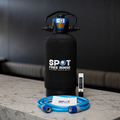
DIY Spot Free Car Rinse
Add a pure water final rinse to your usual home car wash. Connect the tank to your garden hose, rinse and let the car dry without spots.

Spot Free Rinse Tank + Water Fed Pole Kit Bundle

22ft Carbon Fibre Hybrid Water Fed Pole Kit

Spot Free Rinse Purification Tank

Resin Replacement Kits

Water Fed Pole Hose Adapter – 8mm Push Fit + Flow Control + Garden Hose End
- Featured
- Most relevant
- Best selling
- Alphabetically, A-Z
- Alphabetically, Z-A
- Price, low to high
- Price, high to low
- Date, old to new
- Date, new to old
DIY spot free car rinse at home
DIY Spot Free Car Rinse for a Pristine Wash Result
Washing your car at home should be simple, yet the final rinse often lets you down. Tap water carries minerals that leave marks once the surface dries, no matter how careful you are.
A DIY spot free car rinse changes that final step. At Spot Free Rinse, we offer systems that give you better control over water quality, so your car dries cleaner with less effort and less wiping.
DIY Spot Free Rinse Systems for Cars
A DIY spot free car rinse is a practical solution to enhance the outcome when washing at home. A DIY spot free rinse system uses deionised water to remove dissolved solids before the water reaches the vehicle. That gives home users a cleaner final rinse and a simpler way to manage mineral residue left behind as water dries.
Our collection focuses on Spot Free Rinse tanks for DIY car washing. They are built for home users who want a more controlled rinse process. Whether you wash your car every weekend or only when needed, a DIY spot free rinse for cars can fit your cleaning routine.
How a DIY Spot Free Rinse Works
A DIY spot free rinse for cars works by passing water through DI resin. The resin removes dissolved solids from the water supply before the final rinse. When the resin is fresh and within spec, the output can read 0 ppm on a TDS meter. As the resin is used, output rises over time. For this reason, many users reserve the system for the final rinse rather than running it for the entire wash.
This final rinse stage is where water quality matters most. Regular water can leave mineral residue behind on paint, glass, mirrors, and trim as it dries. By reducing those dissolved solids, a DIY spot free rinse system gives home users a cleaner rinse process at the point where finish quality is most noticeable.
Why DIY Users Choose a Spot Free Rinse Setup
For many home detailers and car enthusiasts, the appeal is simple. A DIY spot free rinse helps make the final stage of washing easier and more consistent. Instead of spending extra time managing the last part of the wash, users can build a setup that supports a cleaner rinse from the start.
Common reasons DIY users choose this type of system include:
- Cleaner rinse water at home
- Less dependence on heavy drying
- A more practical final rinse for paint and glass
- A setup that can be added to an existing wash routine
- Portable DI tank options that are easy to connect
For users searching for a DIY spot free car rinse, the focus stays on improving the final rinse.
What You Need for a DIY Spot Free Rinse
A DIY car rinse setup is usually straightforward. In most cases, users need:
- A spot free rinse tank
- A garden hose connection to your water supply
- An outlet hose or rinse setup for the final stage
- A TDS meter to monitor output
The system is designed to integrate with your existing washing process. Many users complete the normal wash first, then switch to DI water for the last rinse. That makes it easier to manage water use and helps extend resin life.
If you are building a DIY spot free rinse for cars, the goal is not to replace your full wash routine. The goal is to improve the final stage with better water.
Built for Home Car Washing
Our collection is designed for people who wash their cars and want a better result at home. It is ideal for enthusiasts, weekend detailers and users who want a cleaner finish on paint, glass, wheels and trim.
A DIY setup also gives users more control over how and when they use deionised water. Some use it on every wash, while others save it for detailed cleans. Either way, the system fits your routine.
Why Choose Us for DIY Spot Free Car Rinse
At Spot Free Rinse, we focus on making the final rinse easier to manage at home.
- We provide systems that fit into a normal home wash routine
- We keep the setup simple, so you spend more time washing, less time adjusting it
- We offer guidance on resin use and system care
- Our products are suited for regular use
- With the right setup, a DIY spot free rinse becomes a natural part of your wash.
How to Choose the Right DIY Spot Free Car Rinse Tank
The right tank depends on how often you wash, your water usage during the final rinse, and your local TDS level. Higher TDS water and higher rinse volume will use resin more quickly. Lower volume users may find a smaller setup works well, while frequent washers may prefer more capacity.
Our range is built for users who want a DIY spot free car rinse that is practical, portable, and suited to home use.
Less Wiping, Better Results Every Time
Drying should not feel like extra work after a full wash. A DIY spot free rinse helps reduce the need for heavy drying, so you can keep your routine simple and consistent.
Get your DIY spot free rinse setup from Spot Free Rinse and turn the final rinse into the step that finishes the job.
Common questions
What do I need for a DIY spot free rinse?
A Spot Free Rinse tank, your own garden hose and your usual wash gear. The tank comes with the bypass head fitted, a TDS meter and a 2m connector hose, and it arrives filled with resin. Wash the car as normal, switch the bypass to pure water for the final rinse and let the car dry.
How do I set up a spot free rinse tank at home?
Connect your garden hose from the tap to the tank's inlet, then attach your spray nozzle or the 2m connector hose to the outlet. That's the setup. Use the bypass to wash with tap water, then switch it to pure water for the final rinse. There's no power, no pump and no plumbing involved.
Can I use a spot free rinse tank with a pressure washer?
Yes. Our tanks are built for real rinse flow rates and are pressure washer compatible, and they have internal filtration to stop resin escaping into your hose fittings or pressure washer. You can also use a normal hose and spray nozzle, or a water fed pole.
Should I wash the whole car with DI water?
No, just the final rinse. Running pure water through the whole wash uses the resin much faster without giving you a better result. Wash with tap water through the bypass, rinse the soap off, then switch to pure water for the last rinse. That's how you get the most litres out of each set of resin.
Does a spot free rinse work with hard water?
Yes. Harder water simply has more dissolved minerals in it, so the resin does more work per litre and a set of resin gives fewer litres before it needs replacing. While the resin is doing its job, the rinse water still comes out pure. The calculator on the tank page shows what to expect for your postcode or your own TDS reading.
How much water does a car rinse use?
Most people use up to about 30 litres for the final rinse on a car. Using pure water for the final rinse only, rather than the whole wash, keeps that number down. Put your postcode into the calculator on the tank page to see how many litres of pure water to expect from a set of resin.
