

You've got a whole house water filter, so even the garden tap gives you filtered water. It's natural to think that means no more water spots on the car. We hear it all the time, and unfortunately that isn't how it works.
The short answer: a whole house filter won't stop water spots, and it won't make a DI tank's resin last longer. The cartridges in a whole house system are built to take out dirt, chlorine and chemicals. The minerals that cause water spots are dissolved in the water, and they go straight through.
Here's what each stage of a typical system does, why it matters whether your water has chlorine or chloramine in it, and what actually gets you a spot free rinse.
Why filtered water still leaves spots
A water spot is what's left when a drop of water dries. The water evaporates, and everything dissolved in it stays behind on the paint or glass: calcium, magnesium, sodium, bicarbonate and the rest. Your TDS meter measures that total in parts per million (ppm).
Filters are very good at catching things carried in the water, like sand, rust and the chemicals carbon can grab. Dissolved minerals aren't bits floating around. They're part of the water itself, like sugar stirred into a cup of tea, so a filter has nothing to catch. Taking them out needs something that pulls the dissolved minerals out of the water, like the resin in a DI tank or a reverse osmosis membrane.
Our guide to what causes water spots on cars goes deeper on the drying side.
What each stage of a whole house filter does
Most whole house systems sit where the water comes into the property, with two or three big cartridges in a row. The line-up varies from brand to brand, but these are the stages you'll usually find.

Sediment filter
Almost always first. It's a fine filter, often rated at 5 or 20 microns, that catches sand, silt, rust and other bits carried in the water. It protects your appliances and the cartridges after it. Dissolved minerals go straight through.
Carbon filter
Usually second. Activated carbon grabs chlorine and a range of chemicals, which is why filtered water tastes and smells better. It comes as loose granules or a pressed block. Either way, carbon doesn't remove dissolved minerals or lower TDS, so calcium, magnesium and sodium pass straight through.
The third stage, if there is one
This is where systems differ most. The common options are:
- A second carbon cartridge. Sometimes it's catalytic carbon, which handles chloramine. More on that below.
- A scale reduction cartridge. It helps stop minerals forming scale inside your pipes, hot water system and appliances. It doesn't take them out of the water, so it doesn't lower your TDS or stop spots on the car.
- A small softening cartridge. A cartridge of softening resin that swaps calcium and magnesium for sodium, exactly like a full size water softener, so the total dissolved solids stay about the same. It holds only a small amount of resin, and a typical one is rated to soften just a few thousand litres of moderately hard water. A household can go through that in a week or two, and once it's used up the hardness comes straight back through until the cartridge is replaced. Our guide to water softeners and DI tanks explains why softened water still spots.
- A UV lamp, mostly on rainwater tank and bore supplies. It kills germs as the water passes through. It doesn't remove anything.
| Stage | What it's for | Lowers TDS? | Stops water spots? |
|---|---|---|---|
| Sediment | Sand, silt and rust | No | No |
| Carbon | Chlorine taste and smell, some chemicals | No | No |
| Catalytic carbon | Chloramine as well as chlorine | No | No |
| Scale reduction | Scale in pipes and appliances | No | No |
| Softening cartridge | Swaps hardness for sodium | No | No |
| UV lamp | Germs in tank or bore water | No | No |
| DI tank (final rinse) | Takes out the dissolved minerals | Yes, to 0 ppm | Yes |
Chlorine or chloramine: does your filter match your water?
This part has nothing to do with water spots, but it matters if you've paid for a whole house filter, and plenty of people have never been told about it.
Water suppliers add a small amount of disinfectant so tap water stays safe all the way to your house. Some use chlorine. Others use chloramine, which is chlorine joined with ammonia. Chloramine lasts longer in the pipes, so it's often used where water travels a long way through a big network.
Which one you get depends on where you live, and some networks use both in different areas. As a rough guide:
- Chloramine is used in parts of South East Queensland, including parts of Brisbane, in parts of Sydney Water's network, and across much of regional South Australia, including the Adelaide Hills, the mid north, Port Pirie, Port Augusta, Whyalla and the Yorke Peninsula.
- Chlorine is the main disinfectant in Melbourne, and in Canberra, Hobart and Darwin.
To be sure, check your water supplier's website or its yearly drinking water quality report, or give them a call.
Here's why it matters for your filter. Standard activated carbon takes chlorine out easily. Chloramine is a much tougher job: it needs a lot more contact time with the carbon, so a standard carbon cartridge at normal household flow lets much of it through. Catalytic carbon is carbon treated so it can break chloramine down, and it's the one you want in a chloramine area, in a cartridge big enough for your flow.

So if you're in a chloramine area and your system only has standard carbon, it's worth asking your installer about a catalytic carbon cartridge. Just remember that neither kind of carbon touches the minerals. It changes how your water tastes and smells, not whether it spots.
Do I need a carbon filter in front of my DI tank?
No. We've tested carbon pre-filters with customers and saw no noticeable difference in resin life, so we don't recommend adding one. In a chloramine area, a standard carbon cartridge barely touches the chloramine anyway. Connect the tank straight to your tap, filtered or not.
What your TDS meter will show
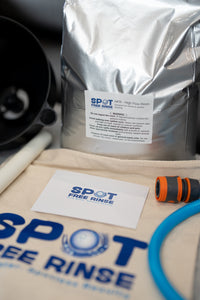
You don't have to take our word for it. Every Spot Free Rinse tank comes with a TDS meter. Fill the meter's cap with water from a filtered tap and the reading will be close to the figure for your area in our tap water TDS guide. Then fill the cap with water from the tank and it reads 0 ppm.

The filtered reading is what decides how far your resin goes, so that's the one to put into our water spot calculator. A whole house filter won't change it much, so expect about the same rinses as you'd get without one.
What actually gets you a spot free rinse
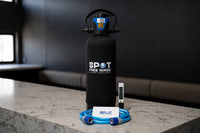
To stop spots, the last water to touch the car needs nothing dissolved in it. That's the job of a DI tank. Its mixed bed resin swaps every dissolved mineral for hydrogen and hydroxide, which join up to make pure water, so the rinse comes out at 0 ppm and dries with nothing left behind.
It works with whatever comes out of your tap, whether it's filtered, softened or straight from the mains:
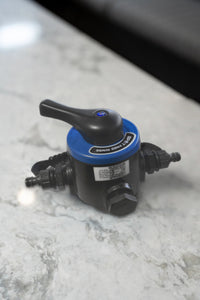
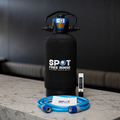
- Connect the tank between your tap and your hose or pressure washer. Our Lite and Pro tanks come with standard Australian garden hose fittings and a 2 m connector hose.
- Wash with the tank's lever on Bypass. The wash runs on plain tap water and saves your resin.
- Flick the lever to Filter for the final rinse. That's the pure water, and the car dries without spots.
Your whole house filter keeps doing its job inside the house, and the tank takes care of the car. They work fine together.
Washing cars or cleaning windows?
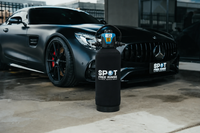
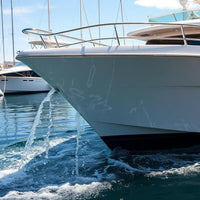
Washing cars, 4WDs, caravans or boats. Our car washing equipment is built around the DI tank, with the bypass head fitted, a TDS meter and a hose in the box. The Lite and Pro tanks go between your tap and your hose or pressure washer. Wash. Rinse. Pack up.
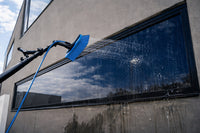
Cleaning windows or solar panels. Our window cleaning equipment pairs the same tank with a water fed pole, and the tank and pole bundle ships the two together.
Whole house filter questions we get asked
Will a whole house water filter stop water spots on my car?
No. The sediment and carbon stages take out dirt, rust, chlorine and some chemicals, but not the dissolved minerals that cause spots. Filtered water reads about the same on a TDS meter and still spots when it dries.
Does a carbon filter lower TDS?
No. Carbon takes out chlorine and a range of chemicals, but calcium, magnesium, sodium and the other dissolved minerals pass straight through, so the TDS reading stays about the same.
What's the difference between chlorine and chloramine?
Both are disinfectants water suppliers add to keep tap water safe. Chloramine is chlorine joined with ammonia, and it lasts longer in the pipes. Standard activated carbon takes chlorine out easily but struggles with chloramine. Catalytic carbon is made to handle chloramine.
How do I know if my water has chloramine?
Check your water supplier's website or its yearly drinking water quality report, or call them. Some networks use chlorine in some areas and chloramine in others.
Does chlorine or chloramine cause water spots?
No. Disinfectant is added at around 0.2 to 2 milligrams per litre, which is tiny next to the 30 to 500 ppm of dissolved minerals in Australian tap water. The spots come from the minerals.
Do I need a carbon filter before my DI tank?
No. We've tested carbon pre-filters with customers and saw no noticeable difference in resin life, so we don't recommend one. Connect the tank straight to your tap.
Will a whole house filter make my DI resin last longer?
Not noticeably. The filter doesn't take out the dissolved minerals, so the resin has the same amount to remove. Use the TDS reading from your filtered tap in the calculator to see what to expect.
Still not sure how your setup will go? Call or text us on 0423 364 936 and we'll work it out together.