
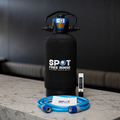
Spot Free Boat Wash System
Wash the salt off as normal, then give the boat a final rinse with pure water. Glass, paint and stainless dry without spots. Portable tanks that run off a garden hose.

Spot Free Rinse Tank + Water Fed Pole Kit Bundle

22ft Carbon Fibre Hybrid Water Fed Pole Kit

Spot Free Rinse Purification Tank

Resin Replacement Kits

Water Fed Pole Hose Adapter – 8mm Push Fit + Flow Control + Garden Hose End
- Featured
- Most relevant
- Best selling
- Alphabetically, A-Z
- Alphabetically, Z-A
- Price, low to high
- Price, high to low
- Date, old to new
- Date, new to old
Spot free boat wash system
Does a Spot Free Boat Wash System Leave a Better Finish?
Most boat owners put a lot of thought into the wash and not much into the rinse. That is usually where the water marks come from. Tap water carries dissolved minerals that dry back onto paint, glass, and fittings once the water evaporates. A spot free boat wash system takes care of that at the final stage before it becomes a problem.
At Spot Free Rinse, our spot free boat rinse tanks remove those minerals before the water ever touches the surface. The process is simple, and the result is consistent. Run the final rinse through deionised water, and the surface dries clean without mineral residue.
What Exactly is a Spot Free Boat Wash System
A spot free boat wash system works at the final rinse stage, running incoming water through DI resin to strip out dissolved solids before they reach the surface. Paint, glass, rails, and exterior fittings all hold onto mineral residue when rinsed with tap water. Removing those dissolved solids beforehand means the surface dries without leaving anything behind.
Spot Free Rinse tanks are built for owners who wash their boats regularly and want the rinse to finish the job. The focus is on making that final stage simpler and more consistent, not adding another step to an already long washdown routine.
How a Spot Free Boat Rinse Works
A spot free boat wash system ensures water dries without leaving marks by removing minerals that normally cause spotting. Because the purification media (DI resin) gradually loses effectiveness with use, it's most efficient to use this treated water only at the final stage where it has the greatest impact on the finished surface.
Step-by-step process:
- Pre-Rinse: Rinse the boat with regular water to remove loose dirt and debris.
- Wash: Clean the surface with standard water and a marine-safe wash soap.
- Initial Rinse: Rinse off soap and remaining grime with regular water.
- Switch to DI System: Activate the spot free system for purified water flow.
- Final Rinse: Rinse the entire boat with DI water to eliminate mineral residue.
- Air Dry: Let the surface dry naturally without wiping to avoid spots.
Where a Boat Wash System Can Be Used
A spot free boat wash system covers painted surfaces, exterior glass, rails and fittings, and other hard exterior surfaces where rinse quality matters. These systems are portable, so they work across different washdown setups with no installation required.
Where it makes the most difference:
- Painted Surfaces: Deionised water dries without leaving mineral marks on boat paint.
- Exterior Glass: Windscreens and port windows come up cleaner with a purified final rinse.
- Rails and Fittings: Metal surfaces that collect residue from tap water rinse off cleaner with DI water.
- Marine Washdown Areas: Any exterior surface that sees regular washdown benefits from a mineral-free final rinse.
How to Choose the Right Spot Free Boat Wash System
The right tank depends on wash frequency, the size of the surfaces being rinsed, and the local TDS level. Higher TDS water works through resin faster, which is worth factoring in before settling on a size. A larger tank suits regular use or bigger surface areas, while a smaller system suits lighter or less frequent washdowns.
This collection is built for buyers looking for a spot free boat rinse or a boat wash system that fits into a real maintenance routine rather than sitting unused between washes.
What to consider before buying:
Tank Size: Match it to how much rinsing you do and the size of the surfaces you are cleaning.
Local TDS Level: Higher TDS water consumes resin faster. Knowing your reading helps you choose the right size.
Wash Frequency: More regular use means the resin gets consumed sooner. Factor that into your choice.
Portability: All Spot Free Rinse tanks are portable and connect to a standard garden hose.
Why Choose Us for Your Boat Wash Setup
We're an Australian-owned business. Our tanks are assembled and tested in Brisbane, and we support everything we sell locally. The tanks are built for Australian conditions, where TDS levels vary across different areas. You get local support, replacement resin always in stock, and a system that is straightforward to maintain.
Australian Owned and Supported: Tanks assembled and tested in Brisbane, shipped locally, with real support from the people behind them.
Tested Before It Ships: Every tank is checked before leaving. Resin quality and output are verified before dispatch.
Resin Always in Stock: Replacement resin kits are available, so your system keeps performing between replacements.
Free Shipping on Tanks: All DI tanks ship free across Australia. Orders ship within the next business day.
Fast Dispatch: Orders ship within the next business day, so you are not waiting around to get started.
Take the Guesswork Out of Your Boat Rinse
Spending time wiping down surfaces that still show marks is a sign the rinse water is the problem, not the wash. Spot Free Rinse DI tanks give you purified water at the final stage, so the surface dries clean without the extra effort. A spot free boat wash system is a straightforward addition to any regular boat care routine.
Common questions
How do you stop water spots on a boat after washing?
Change the last rinse. Wash the boat as normal with tap water and your usual boat wash, rinse the soap off, then switch the tank's bypass to pure water and rinse the whole boat. Tap water leaves its minerals behind as it dries. Pure water has nothing left in it, so the boat dries without spots and without a chamois.
Is deionised water safe on stainless and boat fittings?
Yes. Deionised water is just water with the dissolved minerals taken out. It's safe on paint, glass, chrome, stainless, aluminium, plastic trims and lights. Rails and fittings are where tap water spots tend to stand out most, so a pure water final rinse makes a visible difference there.
Can I take a spot free rinse tank to wherever the boat is?
Yes, as long as there's a tap. The tanks connect to a standard garden hose and run on mains pressure, with no power or pump, so they work in the driveway, the shed or anywhere else with a hose connection. The Lite weighs about 10kg empty and about 12kg filled with water.
What else helps when washing a boat?
A telescopic wash mop makes it easier to reach the high parts of the hull and cabin without climbing. Its chenille head holds plenty of soapy water and is soft on paint and glass. Wash with the mop and tap water, then do the final rinse with pure water from the tank.
Which tank size suits a boat?
It depends on how big the boat is and how often you rinse it. The Lite 10L is our most popular size. If you rinse a larger boat often, the Pro 15L holds more resin and goes further between replacements. The calculator on the tank page shows how many litres to expect from your postcode.
