

You want to know how much water your hose actually puts out, maybe for a pressure washer, a DI tank or just your water bill. There's no need to guess. A bucket and a timer give you your exact garden hose flow rate in about a minute.
The short answer: time how long your hose takes to fill a bucket of known size. Litres in the bucket times 60, divided by the seconds, is your flow in litres per minute. A 10 litre bucket in 60 seconds is 10 L/min, and in 30 seconds it's 20 L/min.
How to measure your garden hose flow rate
- Grab a bucket you know the size of. A 10 litre bucket makes the maths easy, and many have litre marks inside.
- Set the tap and nozzle the way you normally use them. Measure with no nozzle if you want the hose's full flow.
- Start the timer as the water hits the bucket and stop it at the 10 litre mark.
- Work it out: litres times 60, divided by the seconds, equals litres per minute.
- Do it twice and take the average.
| Time to fill a 10 litre bucket | Flow rate |
|---|---|
| 120 seconds | 5 L/min |
| 60 seconds | 10 L/min |
| 40 seconds | 15 L/min |
| 30 seconds | 20 L/min |
| 20 seconds | 30 L/min |
What changes your hose flow rate
- Your water pressure. It varies from street to street, by the time of day, and with other taps running in the house.
- Hose diameter. A wider hose carries more water at the same pressure.
- Hose length. A longer hose loses more along the way, so less comes out the end.
- The nozzle. A trigger nozzle or a fine spray setting cuts the flow a lot compared with an open hose.
- Fittings and kinks. Narrow fittings, a half open tap or a kinked hose all slow it down.
Converting hose flow numbers
- Litres per minute to litres per hour: multiply by 60. 15 L/min is 900 L/h.
- Gallons per minute to litres per minute: multiply by 3.79. American guides use US gallons.
Why your hose flow rate matters when you wash the car
Pressure washers. Your tap needs to supply at least what the pressure washer is rated for, or the pump runs short of water. Check the label against your bucket test, and see our pressure washer flow rate guide for what the numbers mean.
Water restrictions. Some councils ask for a trigger nozzle on a hand held hose, and some add rules during restrictions. Our guide to car washing rules and water restrictions covers your area.
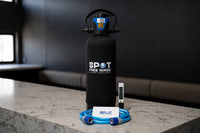
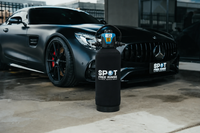
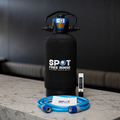
A spot free rinse. An open hose can run a lot faster than a pressure washer. If you rinse through a DI tank, the tank doesn't slow your flow, but the resin has to keep up with it to give you 0 ppm. On soft water it hardly matters. On very hard water there's no need to run the hose wide open. Our Lite's guide is up to 10 L/min, and the Pro and Commercial keep up at higher flows. More in our DI water flow rate guide.
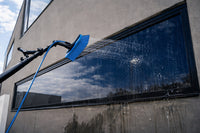
Water fed poles. A pole for windows and solar panels runs a much lower flow than an open hose, usually about 1 to 2.5 L/min at the brush, which you set with the flow control valve. That's why the resin goes so much further on windows. Our guide to how much water a water fed pole uses shows how to measure yours, and our water fed pole guide covers setting it up.
Washing cars or cleaning windows?
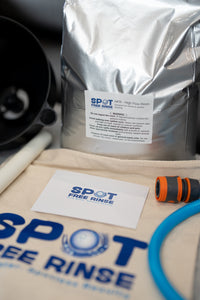
Washing cars, 4WDs, caravans or boats. Our car washing equipment is built around the DI tank, with the bypass head fitted, a TDS meter and a hose in the box. It goes between your tap and your hose or pressure washer, and the Lite, Pro and Commercial tanks all run at full pressure. Wash. Rinse. Pack up.
Cleaning windows or solar panels. Our window cleaning equipment pairs the same tank with a water fed pole. The tank and pole bundle has everything you need to start, and our window cleaning page shows how it works on glass and panels.
Hose flow rate questions
How do I measure my garden hose flow rate?
Time how long it takes to fill a bucket of known size. Litres in the bucket times 60, divided by the seconds, gives you litres per minute. A 10 litre bucket in 60 seconds is 10 L/min.
How many litres per minute does a garden hose use?
It depends on your water pressure, the hose and the nozzle, so the only way to know is to measure it. An open hose can run a lot faster than a pressure washer, and a trigger nozzle cuts it right back.
How do I convert litres per minute to litres per hour?
Multiply by 60. A hose running 15 L/min puts out 900 litres an hour.
Does hose length affect flow rate?
Yes. A longer hose loses more along the way, and a narrower one carries less, so less water comes out the end.
What flow rate suits a DI tank?
Our Lite's guide is up to 10 L/min, which covers most car pressure washers. On soft water it can handle more, and the Pro and Commercial keep up at higher flows.
Still not sure which setup suits you? Call or text us on 0423 364 936 and we'll work it out together.