


You're setting up a water fed pole, or you've got one and want to know how much water it actually puts through. Maybe you're working out how far a set of resin will go, or you just want to know if your flow is about right. The good news is that a pole uses a lot less water than most people expect.
The short answer: most water fed poles run about 1 to 2.5 litres a minute at the brush, and about 2 L/min is the figure you'll hear most. Your own number depends on your valve, your tap and your hose, so the easy way to know is to time it with a jug.
How much water does a water fed pole use?
A common figure for a two jet brush is about 100 to 150 litres an hour. That works out at roughly 1.7 to 2.5 L/min. Some window cleaners run closer to 1 L/min on glass that's cleaned often, and around 2 L/min is a common setting for anyone running a DI tank, because it makes the resin go further.
Here's what those flows add up to while the water's running:
| Flow at the brush | Water in 10 minutes | Water in an hour |
|---|---|---|
| 1 L/min | 10 litres | 60 litres |
| 1.5 L/min | 15 litres | 90 litres |
| 2 L/min | 20 litres | 120 litres |
| 2.5 L/min | 25 litres | 150 litres |
An open garden hose can run many times that. That's why the resin goes so much further on windows than on a car.
How to measure the flow at your brush
You don't need a flow meter. A jug and the timer on your phone will do it.
- Set the valve the way you normally clean.
- Hold the brush head over a bucket so the jets run straight into a measuring jug.
- Time how long it takes to fill 1 litre.
- Litres times 60, divided by the seconds, gives you litres per minute.
| Time to fill 1 litre | Flow at the brush |
|---|---|
| 60 seconds | 1 L/min |
| 40 seconds | 1.5 L/min |
| 30 seconds | 2 L/min |
| 24 seconds | 2.5 L/min |
Do it at the brush, not at the tap. The tap can run far more than the pole ever sees. Our garden hose flow rate guide covers the same test for an open hose.
What sets the flow on a water fed pole
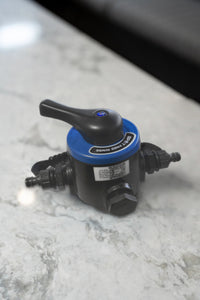
- The flow control valve. This is the main control. On our pole kit it sits at the bottom of the pole, where your garden hose meets the pole hose, with an on/off and a flow control in one.
- Your tap and water pressure. Higher pressure pushes more water through at the same valve setting, and it varies from street to street.
- The pole hose. Pole hose is a narrow line, and 8 mm is the standard size. It doesn't lock your flow at a set number. A long, narrow hose just takes a bit more pressure to push the same flow, so the valve and your tap still decide how much comes out.
- Height. Pushing water up a fully extended pole costs a little pressure, so you may need to open the valve a touch for upstairs windows.
- The jets. Fan jets spread the water wide and pencil jets throw a tighter stream. Our brush has six brass jets, two fan on the outside and four pencil in the middle. The jets change how the water lands. The valve still sets how much.
How much flow do you actually need?
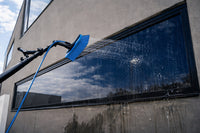
Enough to keep a curtain of water running down the glass below the brush, and to rinse the window from the top down. That's it. You're not blasting dirt off, the brush does the scrubbing and the pure water carries it away.
- Too much: it splashes, runs off the frames, wastes water and uses up resin for no better result.
- Too little: dirty water gets left on the glass, especially on a hot day when the window dries before you've rinsed it.
Start around 2 L/min. Turn it down on glass that's cleaned often, and open it up for a first clean on neglected windows or a hot, windy day. Our water fed pole guide walks through the full technique, including the slow final rinse that decides the finish.
Why a lower flow makes your resin go further
Every litre that comes out of the brush has gone through the resin first. So the less water you run, the more glass you clean on each set of resin. Halve the flow and the same set does twice the brush work.
As a guide, at 300 ppm, which is common south of the Brisbane River, a Lite gives about 850 to 970 litres of pure water per set of resin and a Pro about 1,330 to 1,500 litres. Your tap water changes that a lot, so put your postcode into the calculator on the tank and pole bundle page to see yours. Our resin life guide explains why harder water uses resin faster.
A low flow also suits the resin. Pole flows sit well inside what our tanks can keep up with, so you get 0 ppm at the brush right up until the resin is near the end. Our DI water flow rate guide explains how that works.
Two more ways to save resin:
- On very dirty glass, scrub with tap water on Bypass, then flick to Filter for the final rinse.
- Turn the water off at the valve while you move between windows.
How to set up a water fed pole on a DI tank
- Tap to the IN side of the tank.
- Your garden hose from the OUT side of the tank to the pole's flow control valve.
- The valve into the 8 mm hose that runs up the pole to the brush.
- Turn the tap on, open the valve and set your flow at the brush.

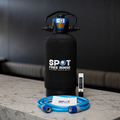
The tank runs straight off your tap. No pump and no power. Check the water at the brush with the TDS meter that comes with every tank. Fresh resin reads 0 ppm, and once it reads about 10 ppm it's time for a resin replacement.
Cleaning windows or washing cars?
Cleaning windows or solar panels. Our window cleaning equipment pairs the DI tank with a water fed pole. The tank and pole bundle has everything you need to start, the 22ft pole kit adds a pole to a tank you already own, and our window cleaning page shows how it works on glass and panels. For the full rundown, see our window cleaning equipment guide.
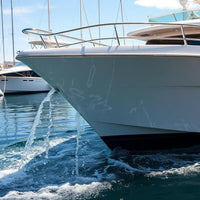
Washing cars, 4WDs, caravans or boats. Our car washing equipment is built around the same tank, with the bypass head fitted, a TDS meter and a hose in the box. It goes between your tap and your hose or pressure washer, and the Lite, Pro and Commercial tanks all run at full pressure. Wash. Rinse. Pack up.
Water fed pole questions we get asked
How much water does a water fed pole use?
Most run about 1 to 2.5 litres a minute at the brush, and about 2 L/min is the figure you'll hear most. A common figure for a two jet brush is 100 to 150 litres an hour.
What flow rate should I run on a water fed pole?
Start around 2 L/min, enough to keep a curtain of water running down the glass below the brush. Turn it down on glass that's cleaned often and up for a first clean or a hot day.
How do I measure the flow on my water fed pole?
Hold the brush over a bucket so the jets run into a measuring jug, and time how long it takes to fill 1 litre. 30 seconds is 2 L/min and 60 seconds is 1 L/min.
What size hose does a water fed pole use?
8 mm is the standard size for pole hose. Ours uses 8 mm push fit, with a flow control valve and a garden hose end, so it connects to the tank with your normal garden hose.
Does an 8 mm hose limit the flow?
Not to a set number. The valve and your tap set the flow. A long, narrow hose just takes a bit more pressure to push the same amount of water.
Does a lower flow make DI resin last longer?
Yes. Every litre at the brush goes through the resin first, so running less water means more glass cleaned on each set of resin.
Do I need a pump for a water fed pole?
Not with our tank. It runs straight off your tap, with no pump and no power.
Not sure which setup suits your windows? Call or text us on 0423 364 936 and we'll work it out together.