


You're looking at pressure washers, or trying to work out what yours can do, and the box is full of numbers: bar, PSI, litres per minute, sometimes litres per hour. For washing a car, two of them matter, and they do different jobs. Here's what pressure washer flow rate means, how it differs from pressure, and what suits a car.
The short answer: flow rate is how much water comes out, in litres per minute (L/min). Pressure is how hard it comes out, in bar or PSI. For washing a car, a moderate pressure of around 1,200 to 1,900 PSI and a flow of about 6 to 9 L/min is a common recommendation, and most home car pressure washers run around 5 to 8 L/min.
Pressure washer flow rate vs PSI
Flow rate is the volume of water the pressure washer puts out. In Australia it's usually listed in litres per minute (L/min) or litres per hour (L/h). American brands use gallons per minute (GPM).
Pressure is how hard the water is pushed out of the nozzle, listed in bar or PSI.
Think of it this way: pressure knocks the grime loose, and flow carries it off the panel. For rinsing a car, flow does most of the work.
How to convert the numbers
- Litres per hour to litres per minute: divide by 60. 420 L/h is 7 L/min.
- Gallons per minute to litres per minute: multiply by 3.79. 2 GPM is about 7.6 L/min.
- Bar to PSI: multiply by 14.5. 100 bar is about 1,450 PSI.
What flow rate and pressure suit washing a car?
Paint, trim and seals don't need much pressure. A common recommendation is around 1,200 to 1,500 PSI for paintwork and up to about 1,900 PSI for heavy grime, with a flow of about 1.5 to 2.5 GPM, roughly 6 to 9 L/min. Most electric home pressure washers sold for cars sit around there.
A few habits matter more than the numbers:
- Use a wide fan tip, around 25 to 40 degrees, on paint. Keep narrow and turbo tips away from paintwork.
- Start about 30 to 45 cm from the panel and keep the lance moving.
- Keep the spray off badges, trim edges and rubber seals.
Is a higher flow rate better?
More flow rinses faster, but you don't need a big commercial machine to wash a car. More flow also means more water through anything in line, like a DI tank, which matters if you finish with a spot free rinse (more on that below).
Can your tap keep up with your pressure washer?
A pressure washer can only put out what it's fed. If your tap can't supply its rated flow, the pump runs short of water, which is hard on it. Check with a bucket: time how long your tap takes to fill a 10 litre bucket. 60 seconds is 10 L/min, and 30 seconds is 20 L/min. If the tap beats your pressure washer's rated flow, you're fine. Our garden hose flow rate guide walks through the test.
Never slow a pressure washer down by restricting its water supply. It needs its full supply to run properly.
Pressure washer flow rate and a DI tank
If you finish with a spot free rinse, your pressure washer draws its water through a DI tank. The tank doesn't restrict your flow. The resin just has to keep up with it to give you 0 ppm. Most home car pressure washers run around 5 to 8 L/min, inside our Lite's guide of up to 10 L/min, and higher flows or very hard water suit the Pro or Commercial. See how to set one up in our guide to a DI water filter for a pressure washer, and why flow matters in our DI water flow rate guide.
Washing cars or cleaning windows?
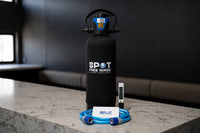
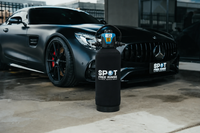
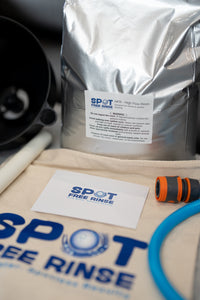
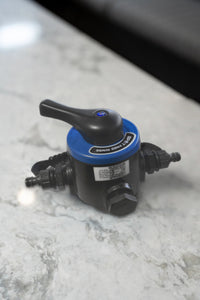
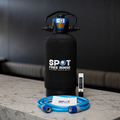
Washing cars, 4WDs, caravans or boats. Our car washing equipment is built around the DI tank, with the bypass head fitted, a TDS meter and a hose in the box. It goes between your tap and your hose or pressure washer, and the Lite, Pro and Commercial tanks all run at full pressure. Wash. Rinse. Pack up.
Cleaning windows or solar panels. Our window cleaning equipment pairs the same tank with a water fed pole. The tank and pole bundle has everything you need to start, and our window cleaning page shows how it works on glass and panels.
Pressure washer flow rate questions
What is a good pressure washer flow rate for washing a car?
About 6 to 9 L/min (roughly 1.5 to 2.5 GPM) is a common recommendation, and most home car pressure washers run around 5 to 8 L/min.
Is PSI or flow rate more important for washing a car?
For rinsing, flow rate. Pressure loosens the grime and flow carries it away. Paintwork doesn't need high pressure, around 1,200 to 1,500 PSI is plenty for most cars.
How do I convert litres per hour to litres per minute?
Divide by 60. A pressure washer rated at 420 L/h runs 7 L/min.
How much flow does a pressure washer need from the tap?
At least its rated flow. Time how long your tap takes to fill a 10 litre bucket: 60 seconds is 10 L/min. Never restrict the supply to a pressure washer.
Can I use a pressure washer with a DI water tank?
Yes. Connect the tank between the tap and the pressure washer's water inlet and it runs at full pressure. Most home car pressure washers sit inside our Lite's 10 L/min guide.
Still not sure which setup suits you? Call or text us on 0423 364 936 and we'll work it out together.